- Atlantic Shades Co Halifax, Nova Scotia, Canada
- info@atlanticshadesco.ca
- 9.30 AM - 6.00 PM

Blind Repair and Window Treatment Restoration in Halifax
Not every blind that stops working properly needs to be replaced. Professional blind repair can sometimes restore a damaged or worn window covering, depending on its condition, construction, and the type of problem involved. Atlantic Shades Co, based in Halifax, Nova Scotia, works with homeowners and property owners across the area who want to know whether their existing blinds and shades can be repaired or restored before they go out and buy new ones.
This page walks through what blind repair actually involves, the kinds of problems that tend to come up, and how to think about repair versus replacement for the window coverings already in your home.
Professional Blind Repair Services
Blind repair can mean a lot of different things depending on what’s actually wrong. Sometimes it’s a single part, like a broken cord lock or a bent bracket. Other times it’s something more structural, like a slat mechanism that’s worn out from years of daily use. Because blinds and shades aren’t all built the same way, figuring out what’s actually broken is the first real step, before anyone talks about fixing or replacing anything.
A proper look at the blind, rather than a guess based on a description over the phone, tends to give a clearer answer. That’s really what separates a useful repair conversation from a shot in the dark.
Common Window Blind Problems That May Need Repair
Most people don’t call about blinds because they’ve decided it’s time for something new. Usually there’s a specific issue that’s making the blind annoying or impossible to use. Some of the more common ones:
- The blind is hard to raise, lower, or tilt, or it gets stuck partway through
- A bracket, slat, or valance has come loose or been damaged
- The lift cord, tilt wand, or clutch mechanism isn’t working the way it used to
- The fabric or vinyl has faded, cracked, or torn over time
- Something’s missing or hanging at an odd angle
- A cordless blind has lost its tension and won’t hold position
- The blind just shows the wear you’d expect after years of regular use
Some of these are simple, isolated fixes. Others point to something bigger going on with the blind as a whole. Part of what a repair assessment does is tell you which of those two situations you’re actually dealing with.
Window Blind Repair and Restoration
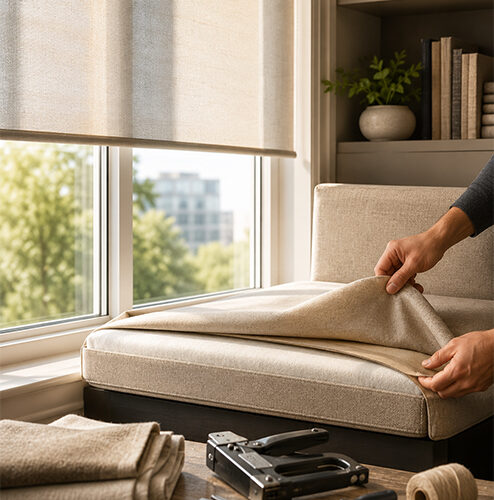
For window coverings, re-upholstery can involve restoring or replacing worn fabric or material while retaining usable components of the existing blind or shade
Window blind repair usually refers to fixing a mechanical issue, such as a broken part, a stuck mechanism, or something that has stopped functioning properly. Restoration, or re-upholstering a window covering, is a bit different. It’s about bringing back the fabric or material side of things when the frame and mechanism are still in decent shape but the covering itself has seen better days.
A roller blind is a good example. If the tube and mechanism still work fine but the fabric has faded or torn, re-covering it can sometimes make more sense than replacing the entire unit. That’s not always the case, though. If the mechanism is also on its way out, or if it’s an older model where finding matching material is difficult, replacement might end up being the more practical route.
Repair, restoration, and replacement aren’t really one option with three names. They’re separate paths, and which one fits depends on the specific blind in front of you.
Roller Blind Repairs
Roller blind repairs come up often, partly because roller blinds are so widely used in both living rooms and home offices. The usual complaints: a roller that doesn’t retract evenly anymore, fabric that’s started to sag or wrinkle, or a mechanism that feels stiff and won’t move the way it should.
How old the blind is, and how it was built in the first place, has a lot to do with whether repair is worth pursuing. A roller blind with a fairly simple tube and spring setup is often a decent candidate for repair, assuming the fabric and hardware are still in reasonable shape. But if the blind’s been sitting in direct sun for years, the fabric might be too brittle or discoloured to work with, even if the mechanism itself is perfectly fine.
Roller blinds vary quite a bit in how they’re made, so it’s worth having the actual unit looked at rather than assuming one fix applies across the board.
Cordless Blind Repair
Cordless blind repair tends to be a different conversation than corded systems, since cordless blinds rely on an internal spring or ratchet mechanism instead of a pull cord. When one of these gets hard to raise or lower, or stops holding its position, the problem is usually inside that mechanism, not something you can see just by looking at the blind.
That’s part of why these need a closer look before anyone jumps to conclusions. Since the mechanism is enclosed, it’s not always obvious from the outside how serious the issue is. Some cordless mechanisms can be adjusted or repaired without much trouble. Others are built into the headrail in a way that limits what repair can actually accomplish, depending on how the blind was made.
If a cordless blind in your home has gotten harder to operate, it’s worth having someone take a look before assuming it’s done for good.
When Should You Repair or Replace Your Blinds?
This isn’t usually a simple call. It comes down to weighing a handful of things together rather than picking based on just one factor.
Age matters, and so does the overall condition of both the mechanism and the covering. The type of blind plays a role too, since some styles are much easier to repair or re-cover than others. Then there’s how much damage there actually is — is it one part, or is it spread across the whole unit? Appearance counts as well, including fading or visible wear, along with whether the blind still functions the way it’s supposed to. Finding the right parts or materials can also be a factor, particularly with older or discontinued products, and sometimes the bigger picture matters too, like whether you’re updating other blinds in the house at the same time anyway.
A blind that’s mostly fine but has one damaged piece is often worth repairing. One that’s worn down across several areas, or where matching parts just aren’t available anymore, tends to make more sense to replace. There’s no formula that covers every case, which is why this really comes down to looking at the specific blind.
Looking for Blinds Repairs Near Me in Halifax?
If you’ve searched for blinds repairs near me, you’re probably after a window covering service that’s easy to reach and familiar with the kinds of blinds common in local homes. Working with someone based nearby tends to make the whole process simpler, since scheduling and follow up are usually more straightforward when you’re not dealing with a company that’s a long drive away.
For homeowners in Halifax and surrounding areas, choosing a local window covering service can also make scheduling, assessment, and follow up more convenient.
Why Professional Blind Repair Matters
It’s tempting to guess at a fix based on how a blind looks or behaves, but blinds have several parts that work together, and a problem in one spot can sometimes be caused by something else entirely. A proper assessment helps pin down what’s actually wrong rather than treating a symptom and hoping it sticks.
It also helps set expectations that make sense. Not every blind can be repaired, and a repair won’t always leave a blind looking or performing exactly like it did new. Knowing the real condition of a blind before deciding what to do with it helps you make a call that actually fits your situation, rather than hoping for the best.
Blind Repair Services in Halifax, Nova Scotia
Atlantic Shades Co works with homeowners across Halifax, Nova Scotia dealing with blinds and shades that have stopped working properly. Whether it’s a roller blind that won’t roll evenly anymore, a cordless mechanism that’s lost its tension, or a covering that’s simply worn out, the process generally starts the same way — taking a real look at the specific blind to understand what’s actually going on with it.
From there, it’s usually a lot easier to say whether repair, restoration, or replacement is the more sensible move for that particular window covering.
Frequently Asked Questions
Can every blind be repaired?
No, not always. It really depends on the blind’s age, how it’s built, and how extensive the damage is. Some problems are small and isolated. Others affect the blind more broadly and point toward replacement instead.
How do I know if I should repair or replace my blinds?
It usually comes down to a mix of things — age, condition, the type of damage, and whether matching parts or materials are still around. Having the specific blind looked at is generally the most reliable way to figure this out.
What’s the difference between blind repair and re-upholstery?
Blind repair generally means fixing mechanical parts, like a lift system or a bracket. Re-upholstery, when it comes to window coverings, means re-covering or restoring the fabric portion, such as the covering on a roller blind.
Are roller blinds easy to fix?
It depends on what’s wrong and how the blind’s holding up overall. Roller blind repairs often come down to the mechanism, the fabric, or the fittings, so the right approach depends on which of those is the actual problem.
Why is my cordless blind harder to use than it used to be?
This is usually related to the internal spring or ratchet system that controls the cordless mechanism. These can lose tension over time or stop responding the way they should, which is why cordless blind repair usually starts with looking at that mechanism specifically.
Is it worth fixing an older blind?
That depends on the blind’s overall condition and whether parts or materials are still available for it. Some older blinds are still good candidates for repair. Others make more sense to replace, especially if the mechanism itself is outdated or failing.
Do you repair blinds for homeowners near Halifax?
Atlantic Shades Co works with homeowners in Halifax, Nova Scotia and the surrounding area on window covering repair and restoration. Reaching out with some details about your blind is the easiest way to find out what might be possible.
What should I do before deciding to replace my blinds?
It’s worth having the blind assessed first. Sometimes a repair or a re-covering solves the problem without the cost of a full replacement, but that really depends on the condition of that specific blind.
Contact Atlantic Shades Co
If the blinds or shades in your Halifax home aren’t working the way they should, it’s worth finding out what your actual options are before deciding a full replacement is the only path. Atlantic Shades Co works with homeowners across Halifax, Nova Scotia to take a look at existing window coverings and figure out whether repair, restoration, or replacement makes the most sense. Reach out to talk through what’s going on with your blinds and get them working properly again.